Showing posts with label Languages. Show all posts

Tuesday, 29 October 2013

Donostia San Sebastián


A weekend in Spain


We took a trip to San Sebastián last weekend to make the most of the unseasonably warm October weather.

The harbour and bay area


Don Quixote and Sancho Panza


Boys in football gear


San Sebastián is a beautiful, lively city in the Basque region of Spain. The busy shopping area is located right next to the beach. Spanish families eat ice creams and mingle with tourists in the old city. Children play football in the streets, or enjoy the park on the seafront.


Basilica of Saint Mary of the Chorus


Carousel in front of City Hall


Children dressed alike
Adults dressed alike, maybe they're brothers
   
 A stroll through the narrow city streets led us to tapas, and more tapas. Or Pintxos in Basque. Delicious. Although (and I have a hazy memory of a forgotten new year's resolution) my Spanish did let me down badly. The words came out in Italian, in French, even in Irish (!)...  But we still managed to eat well by pointing and gesturing. The locals are used to the influx of tourists, especially French (it's only a half an hour from Biarritz) and switched easily from Spanish and Basque to French and English.


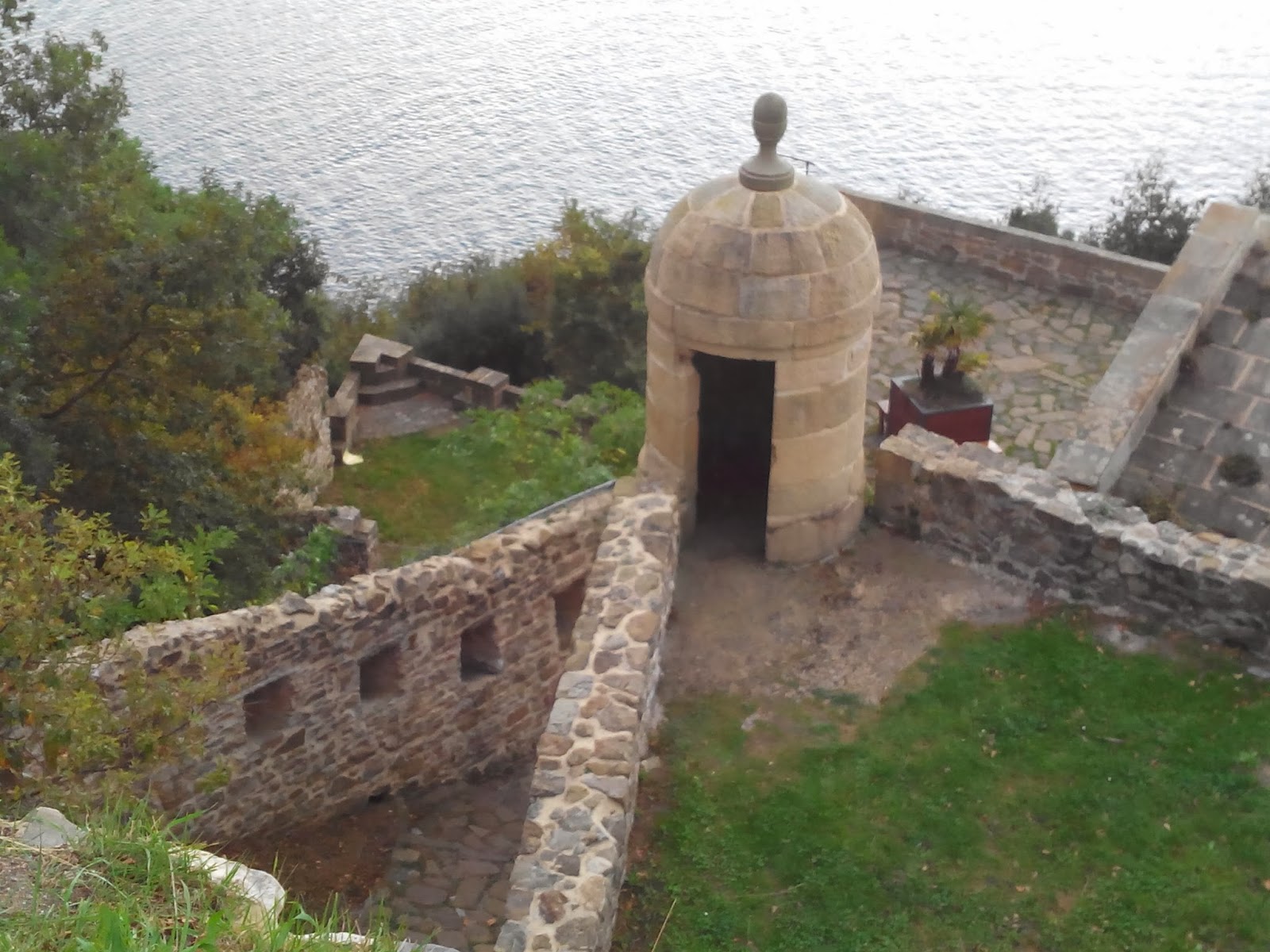
The best views of the city were to be enjoyed from Mount Urgull. We climbed up through the park to the historic castle and the statue of Jesus overlooking the city. My calf muscles are nearly back to normal now, thanks for asking.


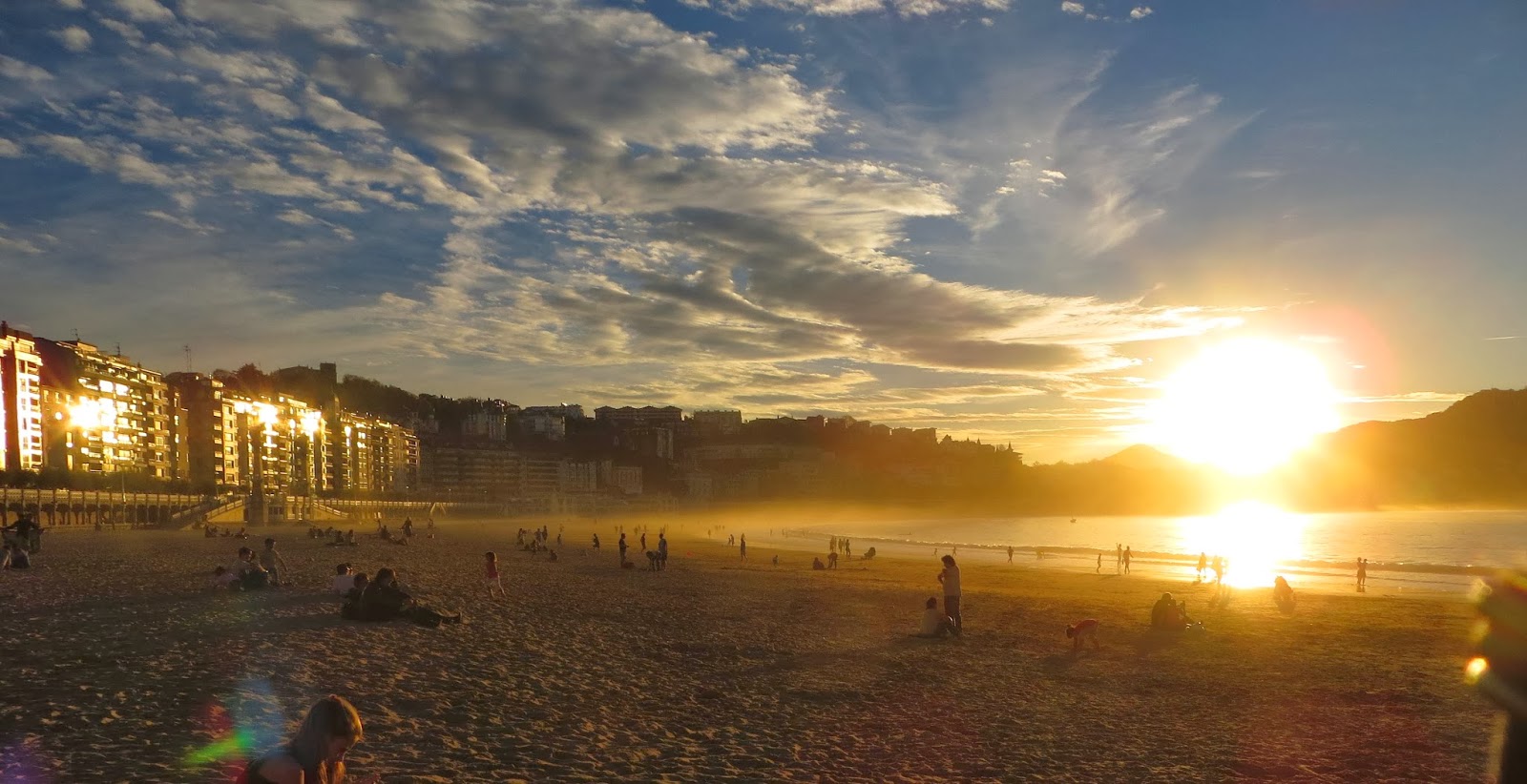
Playa de la Concha was ideal for people-watching. A bride and groom arrived down from the city hall for a photo shoot--the bride struggling through the sand with her long white dress, the groom carrying the Champagne and glasses for that perfect photo. Children played in the sand--often naked, as seems to be the norm. The melodious tune of a saxophonist on the promenade wafted down towards us. A businessman arrived after work with a novel, stripped down to his boxers, and went in for a swim. Then he lay there reading until he was dry enough to put back on his shirt and tie and head home. Made me wish I lived closer to the sea.


Certainly the nicest city beach I've ever visited.


Wednesday, 9 October 2013

Literature in translation

When I ordered the summer edition of The Stinging Fly I discovered it was dedicated to literature in translation and included fiction from Belgium, Italy, China, Poland, Rwanda, Ukraine, Morocco, Greece, Netherlands, Spain, Austria, Brazil and Finland.

The translators of these stories were interviewed for the journal. They were asked: Why is literature in translation important? What is your reaction to the term untranslatable? How would you describe your relationship with the author after you get involved with the translation? Responses were fascinating. I hadn't considered the relationship between the translator and the author, or how the author can lose a little of their own book when it's been translated into a language they can't read.


Having studied Applied Languages (French and German), I was oriented towards employment as a translator. After graduation, I managed three months in a tiny translation agency, where the work was mind-numbingly boring and the working environment was less than attractive. (My boss used to kick holes in the walls in childish tantrum when things weren't going his way. Not a nurturing environment!) I translated German accident reports for insurance companies. Every report started with 'I was driving on the left when...'

Technical translation and localisation were not for me, however I did and do remain in awe of literary translation. You can learn so much about language by trying to render an expression written in another language into English, or from English into another language. Metaphors, similes, regional dialects--they require the translator to stop, reflect, choose. We mull over the connotations of one word over another. Even simple vocabulary is not straightforward. A castle is a château in French, but the mental images we create when we hear those words are very different.

Haruki Murakami spent many years translating some of the great novels into Japanese. He wrote, about his translation of The Great Gatsby: “Although numerous literary works might properly be called ‘ageless', no translation belongs in that category. Translation, after all, is a matter of  linguistic technique, which naturally ages as the particulars of a language change. Thus, while there are undying works, on principle there can be no undying translations.”

In Claire Kilroy's essay, in the translation issue of The Stinging Fly, she tells a great story about one of her pieces that was translated into German. She discovered that the sentence 'The men were padding around the boardroom' had been translated as 'the men were walking about in bare feet like animals'. This is a worrying thought for any author whose books are translated into languages they don't speak and can't check.