Showing posts with label Writing. Show all posts

Tuesday, 11 March 2014

Review: 'The Three Musketeers' by Alexandre DUMAS

Statue of D'Artagnan in Auch, Gers

The Three Musketeers by Alexandre DUMAS


Written in serialised form in 1844, and set around 1625 in the France of Louis XIII, Louis XIV, Anne of Austria and bishop Richelieu, Les Trois Mousquetaires is a story of adventure that still delights and entertains. Although historically inaccurate in places, it is rich in colour and atmosphere, full of witty dialogue and drama. It is the first in a trilogy about D’Artagnan (other books are Twenty Years After, and The Vicomte de Bragelonne).


D’Artagnan is a brave but temperamental Gascon who makes his way to Paris on a yellow horse, encountering adventures on the way. He provokes duels with each of the three musketeers - Athos, Porthos and Aramis - when he first meets them in Paris. However they join forces to fight the bishop’s guards and forget their differences and become friends. D'Artagnan dreams of joining the Musketeers - the King’s guards -  and is finally admitted to the Musketeers at the Siege of La Rochelle. D'Artagnan also falls in love with Madame Bonacieux and embarks on a quest to save her, a quest which takes him to England and back, and which also saves Queen Anne of Austria’s reputation.


Les Trois Mousquetaires first appeared in serialised form in 1844

A Gascon

Dumas’ genius must lie in the characters he creates. Like Dickens, his characters attract and hold our interest and D’Artagnan remains one of the most well-known and well-loved characters of all time. Much is made of the fact that D'Artagnan is a Gascon.

He had the power of seeing in the night:


‘It is said that the eyes of Gascons, like those of cats, have the faculty of seeing in the night. D’Artagnon was able to see therefore…’

He was proud:

‘Proud as a Scotchman, muttered Buckingham. ‘And we,’ answered d’Artagnan, say ‘proud as a Gascon’. The Gascons are the Scotchmen of France.’

And crafty:

‘Imagine Don Quixote at eighteen; Don Quixote without his corselet, without his coat of mail, without his cuisses, a Don Quixote clothed in a woollen doublet… face long and brown, high cheek bones, indicating craftiness, the maxillary muscles enormously developed, an infallible sign by which a Gascon may always be detected even without his cap…’

 And brave:
‘Our brave Gascon has just shown himself as brave and as faithful as ever.’


D’Artagnan was clever enough to be able to read people just by looking at the countenance of those he encountered:


‘It was not a landlord this time but a landlady who received him. D’Artagnan, being somewhat of a physiognomist, examined at a glance the fat and good-humoured face of the mistress of the place. This glance satisfied him that dissimulation was not necessary with her and that he had nothing to fear from such a happy-looking countenance.’


Women

Women in Dumas' world could be weak, powerful,  cunning, charming, vindictive, and capable of sorcery.


‘There was an understanding between this lady and Porthos. If she was a lady of quality she would have fainted, but, as she was only a solicitor’s wife, she contented herself with saying in a concentrated rage…’


‘The enchantress had resumed that magic charm which she took up and laid aside at pleasure, that is to say beauty, softness, tears and above all the irresistible attraction of that mystical voluptuousness which is the most irresistible of all kinds of voluptuousness.’


‘Her ladyship wished to please the Abysse and this was a very easy task for a woman so truely superior. She endeavoured to be amiable and became charming so that her entertainer was seduced by her varied conversation as well as by the grades which appeared in all her person.’


I'm particularly amazed at this feisty lady:


'Athos examined it (the ring) and became very pale. He then tried it on the ring finger… A shade of anger and revenge passed across the generally calm forehead of the gentleman.


She turned, no longer like a mere furious woman, but like a wounded panther.


‘Ah, wretch,’ said she, ‘you have betrayed me like a coward, and, moreover, you have learned my secret. You must die.’


And she ran to an inlaid cabinet on her toilet table, opened it with a feverish, trembling hand, drew from it a small dagger with a golden hilt and a sharp and slender blade and returned with one bound to the side of d’Artagnan, her vesture in pieces. Although the young man was, as we know, brave, he was frightened at that convulsed countenance, at those horrible dilated pupils, at those pale cheeks and bleeding lips. He arose and recoiled as from the approach of a serpent that had crawled towards him and, instinctively putting his perspiring hand to his sword, he drew it from the sheath. But…. her Ladyship still advanced to strike him.


Her Ladyship was rushing at him in horrible transports of rage and howling in a fearful manner…’
 

The English

Dumas manages to slip in a few amusing digs at English food:


‘The English, who above all things require to be well-fed in order to prove good-soldiers, eating only salted provisions and bad biscuits, had many invalids in their camp.’


And comments on the weather in England:

‘It was one of those few and fine summer days when Englishmen remember that there is a sun.’


Food

Proper sustenance is critical for the French, even in the midst of battle:


‘We are four against one... about to be engaged to a far greater amount of foes…. How many persons? Twenty men. How far off are they? About 500 paces. Good, we have still time to finish this fowl and to drink a glass of wine. To your health, d’Artagnan!’


The musketeers even ask the enemy to hold off the battle until after breakfast:


‘Gentlemen, we are some of my friends and myself engaged in breakfasting in this bastion. Now you know that nothing is more disagreeable than to be disturbed at breakfast, so we entreat of you… to wait until we have finished our repast or to come back in a little while unless… and coming to drink with us to the health of the King of France.’


Loose ends

The story in this book meanders and detours. Some of the loose ends are conveniently tied up, like where her Ladyship might be found. The name of the town they will later need to locate actually falls out of someone's hat:


‘Hello sir. Here is a paper which fell out of your hat. Hello sir, hello.’


‘My friend,’ said d’Artagnan, ‘half a pistole for that paper.’


‘With the greatest pleasure, here it is.’


D’Artagnan unfolded the paper. Only one word…the name of a town… Armentieres…. is written in her hand… let us take great care of this paper…’


Her Ladyship decides to wait for the cardinal’s orders in a convent, which also happens to be the convent where Madame Bonacieux is being held:


‘I am proceeding to the Carmelite convent at Bethune where I shall await your orders.’


'All for one and one for all'

The famous slogan is only referred to once in the book, although there are many duels and shows of bravery.

Some of the pleasure in reading this book is the fact that the real D’Artagnan (Charles de Batz de Castelmore d'Artagnan)  on whom Dumas based his character, came from Lupiac, a village in Gascony. So, whilst reading the book, I paid a visit to the Musée D'Artagnan in Lupiac and was transported to the 17th century. It was easy to imagine the proud D’Artagnan,  leaving the area as a boy and returning many years later leading the King’s guard. The entourage travelled through France and Gascony on the way to St Jean de Luz where Louis XIV wed Marie-Thèrese of Austria.

Monday, 20 January 2014

Short Story: 'Foster' by Claire Keegan

Foster by Claire Keegan won the Davy Byrnes Irish Writing Award in 2009 and had been recommended to me by several people. I bought the Stinging Fly edition and look forward to reading the other stories in this anthology.

Foster is a long short story, subsequently published by Faber&Faber as a standalone book.
The story is told through the point of view of a young girl who has been sent off to live with distant relations while her mother is pregnant with her baby brother. Nobody explains to her where she's going or for how long but we understand a lot about her character and her life by her observations on the journey to her new home.
'We pass through the village of Shillelagh where my father lost our red Shorthorn in a game of forty-five.'
 Her fluctuating expectations of what the family will be like give us an insight into what her own father is probably like:

'He will take me to town on the tractor and buy me red lemonade and crisps. Or he'll make me clean out sheds and pick stones and pull ragweed and docks out of the fields.'

The element of this story that makes it outstanding for me is the dialogue. This is the first exchange between the girl and the foster mother:

'The last time I saw you, you were in the pram,' she says, and stands back, expecting an answer.
'The pram's broken.'
'What happened at all?'
 'My brother used it for a wheelbarrow and the wheel fell off.'

This is certainly not a Hollywood movie--no hugging and consoling. The conversation continues:

So how is your mammy keeping?'
'She won a tenner on the prize bonds.'
'She did not.'
'She did,' I say. 
The girl doesn't complain about anything and just accepts her lot. She notices the neatness and order of the foster home. She sees the respectful way the couple speak to each other, how each job on the farm and in the house is done properly, methodically. Neighbours come to the house unexpectedly and Kinsella goes with them straight away to help. These are good people. Through all her observations, we realise that her home life was far from perfect. Her mother has a clatter (not clear how many) of children and they have very little money. Yet the girl misses her mother and hopes to go home.

As the story unfolds we learn more about the couple who have taken her in and their own personal tragedy, but so much is left unsaid. Somehow we know much more about these characters than the author has told us directly. We are able to imagine their whole lives.

Claire Keegan wrote about Foster:
'It's essentially about trusting in the reader's intelligence rather than labouring a point. To work on the level of suggestion is what I aim for in all my writing.'

The narrator doesn't tell us much about her father or Kinsella yet we get a feel for them through the dialogue, even though they don't say very much at all.
'Dan,' he says, and tightens himself. 'What way are you?'
'John,' Da says.
They stand, looking out over the yard for a moment and then they are talking rain: how little rain there is, how the fields need rain, how the priest in Kilmuckridge prayed for rain that very morning, how a summer like it was never before known.'
Although the girl is dirty and undernourished, the author avoids the cliché of depicting her as the product of poor, miserable Ireland in the 80s. Instead we find that the girl is happy with her lot. The experience of the summer with the Kinsellas has enriched her life.

And we see, from the walk on the beach with Kinsella, that she too has enriched his.

'He shines the light along the strand to find our footprints, to follow them back, but the only prints he can find are mine.
'You must have carried me there,' he says.'
 

Claire Keegan is reading tomorrow 21st January 8pm in Howth Yacht Club.
(ref )


 Davy Byrnes Short Story Award is currently open for submissions.


Saturday, 14 December 2013

Spontaneity


The first issue of Spontaneity is a visual and creative delight. The mix of art, prose and poetry is enthralling, intoxicating.

Here's what Spontaneity has set out to do: 'Our theme of Age and Beauty has been explored in many ways and through different genres. We hope that each piece speaks to its companion on the page, sometimes overtly, sometimes in a more abstract connection. We have only just begun; now  – it’s up to you. If you are inspired by something you read or see here, consider submitting to our next edition – which will evolve from this first little acorn... Spontaneity is all about a creative chain reaction – so it’s crucial you tell us which piece inspired yours.'

I love the video 'Danielle' by Anthony Cerniello that appears on the same page as my piece 'Effie's great-great-great-great Granny.'

The concept reminds me of a website that I love and I thought I'd share here: http://artistsinspireartists.com/


Monday, 18 November 2013

Reading List

Just finished:


'Fun Home' by Alison Bechdel
I hadn't read a graphic novel before and was amazed what graphics can bring to text. There were no superheroes though in this comic. It is an autobiographical account of the author's life as she examines her homosexuality, mulling over every childhood memory. She wonders why her father died - whether it was suicide or not. She also examines whether her 'coming out' had anything to do with his death. And whether his death had anything to do with the possibility that he was bisexual. An honest and insightful story, with a smattering of interesting literary references. A book I'll definitely read again.


'A Visit from the Goon Squad' by Jennifer Egan
This is described as 'a new classic of American fiction' by Time. Made up of interrelated stories that form a whole. Some characters appear in one chapter, then reappear older and more decrepit in another. I loved this book, yet felt frustrated, as I often do in these type of novels. I can't relax, wondering whether a minor character is just that, or whether they'll take over the story later. I find myself flicking back and forth trying to remember where a character appeared before. I need to read this again.


Currently Reading:


'The Luminaries' by Eleanor Catton
I was planning on reading all the books on the Man Booker shortlist but only managed to read 'Translantic' by Colum McCann and 'Almost English' by Charlotte Mendelson before the award (both fantastic and highly-recommended). So now I'm listening to the winning book on Audible. It is set during the gold rush in New Zealand in the 1860s and the cast of characters is vast. There is a Chinese opium dealer, a Scottish prospector, a whoremonger, a politician, a French legal clerk and a ship captain... among others. This book reads like a classic, with somewhat old-fashioned language and narrative techniques. I'm about two-thirds of the way through and highly recommend it.


 'The Spinning Heart' by Donal Ryan
A debut novel from Donal Ryan, dealing with the property boom and bust in Ireland and how it touched the lives of various people (21 narrators). The writing is honest and beautiful, with distinctive voices, which makes it a very easy book to read. I read the first half in one sitting and looking forward to reading the second half tonight. The first paragraph really draws you in. The narrator, talking about his father, says: 'I go there every day to see is he dead and every day he lets me down. He hasn't yet missed a day of letting me down.' I'll certainly order Donal Ryan's new novel 'The Thing About December' as well.


'Mud' by Michèle Roberts   This is a short story collection. I bought it when I went to hear Michèle speak at the International Short Story Festival in Cork in September. Michèle's writing is rich and sensual, and to hear her read was a pleasure. As with all short story collections, I'm dipping in and out of this slowly to absorb each set of characters and settings better. As Michèle is half-French half-English, I'm particularly interested in her use of language and her settings.


'Young Skins' by Colin Barrett
This is short story collection published by The Stinging Fly. I've read just a couple of the stories so far and love the settings and characters. These midlands-Irish males are so familiar yet under-represented in literature. Brings out the culchie in me!


In the to-read pile:


'After the Fire, A still small voice' by Evie Wyld
I bought this after I read Evie Wyld's story in the Granta 123 magazine. Looking forward to reading it, especially as it's set on Australia's East coast (of which I have many fond memories as a backpacker).


Monday, 11 November 2013

Press 'Submit'

Submit by email. Save the trees.
A carved trunk in Aire sur l'Adour

Upload file and press 'Submit'

I started writing my first novel when I was 17 and submitted it to an editor when I was 21. It was, I thought at the time, an enthralling tale about life in boarding school in Ireland. I remember making the decision to spend half my food budget on the purchase of the Writers' & Artists' Yearbook. I devoured the pages devoted to Irish agents and publishers and chose one lucky editor. I printed off my novel, put it in an envelope and posted it, enclosing an SAE. It cost me a bloody fortune. I didn't know I'd have to wait for six months before I got a reply. I didn't write anything during the wait. When I got a standard rejection I put that novel in a drawer and started another.

My second novel was better. I had learned a little from writing and editing the first. I also had a bit more life-experience to draw from. But, instead of sending this one to an editor, I decided to pay for a professional critique: a sizable expense considering I was earning a tiny salary working as a telemarketer. But I felt it was an investment in my writing career. The critique I received was probably accurate, but terribly off-putting. I deposited my manuscript in the drawer alongside my first.

My third attempt was a children's book. I wrote the first draft and decided I wasn't really a children's writer. I didn't even read children's books at that stage. Fail. Drawer.

I gave up writing for about five years. The freedom! Now I could watch TV like ordinary people without feeling like I should be chipping away at a manuscript into the early hours. I joined a karate club. I took up the flute. I had three children. But eventually the lure of the quill pencil keyboard was too strong.

By now things had changed. Editors and agents had websites with submission guidelines. Published authors had websites and blogs. There were forums for emerging writers, places to exchange critiques, lists of competitions and literary magazines. All this information was free. I spent about a year learning about the craft of writing and finding out about the industry. I wrote short stories and a new novel. Then I came out: I admitted to friends and family that I was a closet writer. In fact I'd won a prize and was to read my short story at a prize-giving ceremony in Birmingham.

In a way I think it's easier for authors these days. Certainly the submission process is easier. Up-to-date submission guidelines are available online. Most agents accept submissions by email or by Submittable (online form). No postage. No printing costs. Save the trees and all that!


This tree trunk fascinates me
every time I visit this park.
Themes of books,
 music and dancing
carved into the wood.
 
I'm proud of my fourth novel, Lost in Lourdes, which is out on submission at the moment. Even after several big rewrites I still love the story and my characters and believe it will be published. But this time, instead of waiting for a reply, I'm tinkering away at my next project.


Tuesday, 22 October 2013

Le requin marteau et les jours de la semaine

Le requin marteau et les jours de la semaine - Martin
My nine-year-old son came home from school last week begging to be brought to hear David Dumortier reading poetry in the library that evening. He's not usually a bookish kid--more an outdoorsy type--so I was rather surprised. He went on to explain that David had been to his school that afternoon and had performed magic tricks. Aha! He wanted to see a magician, not a poet.

David is a fantastic entertainer. Reciting poetry, embedded in magic tricks, he made the kids laugh. One child was brought to the stage to learn how to do nothing. David had invented a machine to help him. The kid sat winding a handle on a toy that did nothing. Every time he stopped he was prodded to 'keep it up, do nothing' and he had to wind again.

Meanwhile a child helped carry a magician's hat around the audience and David pulled out lines of poetry, read them and threw them into the air. My son grappled with the rest of the kids to grab as many as he could.

It was a great performance. He's a great speaker. He also managed to sell a few books. But, as a writer, I'm depressed at the idea of having to do a similar performance to sell my work. These days it seems that writing the book is only part of the deal. Engaging with the public to persuade them to buy it is a huge part of the writer's job. But what do you do if you're not naturally a magician or entertainer?

The outcome for my nine-year-old: He begged if he could write a poem before bed. I agreed (bemused, amazed). He produced the above poem. He announced that it was 'full of originality' (Then he checked what originality means.) Still, I'd call that a result!

Wednesday, 9 October 2013

Literature in translation

When I ordered the summer edition of The Stinging Fly I discovered it was dedicated to literature in translation and included fiction from Belgium, Italy, China, Poland, Rwanda, Ukraine, Morocco, Greece, Netherlands, Spain, Austria, Brazil and Finland.

The translators of these stories were interviewed for the journal. They were asked: Why is literature in translation important? What is your reaction to the term untranslatable? How would you describe your relationship with the author after you get involved with the translation? Responses were fascinating. I hadn't considered the relationship between the translator and the author, or how the author can lose a little of their own book when it's been translated into a language they can't read.


Having studied Applied Languages (French and German), I was oriented towards employment as a translator. After graduation, I managed three months in a tiny translation agency, where the work was mind-numbingly boring and the working environment was less than attractive. (My boss used to kick holes in the walls in childish tantrum when things weren't going his way. Not a nurturing environment!) I translated German accident reports for insurance companies. Every report started with 'I was driving on the left when...'

Technical translation and localisation were not for me, however I did and do remain in awe of literary translation. You can learn so much about language by trying to render an expression written in another language into English, or from English into another language. Metaphors, similes, regional dialects--they require the translator to stop, reflect, choose. We mull over the connotations of one word over another. Even simple vocabulary is not straightforward. A castle is a château in French, but the mental images we create when we hear those words are very different.

Haruki Murakami spent many years translating some of the great novels into Japanese. He wrote, about his translation of The Great Gatsby: “Although numerous literary works might properly be called ‘ageless', no translation belongs in that category. Translation, after all, is a matter of  linguistic technique, which naturally ages as the particulars of a language change. Thus, while there are undying works, on principle there can be no undying translations.”

In Claire Kilroy's essay, in the translation issue of The Stinging Fly, she tells a great story about one of her pieces that was translated into German. She discovered that the sentence 'The men were padding around the boardroom' had been translated as 'the men were walking about in bare feet like animals'. This is a worrying thought for any author whose books are translated into languages they don't speak and can't check.


Sunday, 29 September 2013

writing.ie

I was pleased this week that my piece Essential Advice: RTE Guide Penguin Publishing Day was published on writing.ie and I hope it has given any writers who didn't attend the day a better insight into what the industry is looking for, how to improve your writing and tips on getting published.

On Saturday I watched a workshop on Children's Writing on WritersWebTV presented by Vanessa O'Loughlin. Interviews with authors and illustrators, writing exercises, comments from a panel and from the public via Twitter, email and Facebook, it addressed many questions and was really useful. I only managed to dip in and out all day as I had children to ferry to endless activities, but the course can be purchased for anyone who missed it live.

The plan for WritersWebTV is ambitious and I'm looking forward to courses including Getting to the Heart of it: Writing Women’s Fiction on Tuesday, October 15th, Crime Pays: Writing Crime Fiction on Wednesday, October 30th, and Getting Published on Saturday, November 9th. Recommended viewing, very professional and very helpful.

Thursday, 26 September 2013

New! Published Works Page


I've added new pages to my blog: details of published stories and some samples on the 'Short Stories' page.

To begin with I would like to share my short story 'Kalashnikov for Shoes' which won the Writing West Midlands Short Fiction Competition earlier this year. I was invited to Birmingham to read my story and accept my prize and it was really a proud moment.

With kind permission from Writing West Midlands I quote from Sian Buckley's blog:

'The Short Fiction Competition turned out to be a beautiful intimate event where we enjoyed wine and readings of the winners’ short stories. Each was presented with their award by the wonderful Tiffany Murray and, being the sociable bunch that they were, everyone ended up staying late to chat and swap contact details (and drink more wine!). We were amazed to discover that Hilary McGrath, the first place winner, had drawn inspiration for her story, Kalashnikov for Shoes, from her friend Sumaya, who had travelled all the way from Kurdistan especially for the reception – not only that but she and runner up Ed Briggs had both travelled from France for the occasion! It was an honour to have them there and of course our more local winners; Ken Elkes and Garrie Fletcher.'


And this is what novelist and guest judge Tiffany Murray said about Kalashnikov for Shoes: ‘This is a big, sweeping journey. It’s one that tells the story of these particular characters, but also one that tells a story of a whole nation. It’s hard to get such ‘bigness’ into a very short story without becoming sweeping, general, or mawkish. I think Kalashnikov for Shoes succeeds. Of course it starts with a great title.

'Shiro and his Aunt’s family are travelling across a border, through the mountains. Their guide is Khalid. Shiro’s cousin, Sa’eeda is lame. It’s a hard journey. They reach their destination. This is the story, but the third person works very well here, taking us step by step; letting these characters speak, focusing on simple showing, on clear unfussy detail. This is a short story that shows the reader a big canvas with detailed, light brushstrokes  – it is a snapshot, and one that certainly lingered with me.’

Read the story here.


Friday, 20 September 2013

They actually don't bite

The RTE Guide/Penguin publishing day


So, a first experience of meeting editors and publicists and people-in-the-know in the writing world--and they actually don't bite.


The room in Pearse Street Library was buzzing with the group of writers longlisted for the RTE Guide/Penguin Ireland short story competition. We were looking forward to a day of talks and workshops, not to mention the networking opportunity and the chicken and stuffing sandwiches. The line-up included Jane Alger, Dublin UNESCO City of Literature and Cliona Lewis, Publicity Director, Penguin Ireland, who spoke about the industry in its current state, with some warnings about how hard it is to get published and how polished the manuscript needs to be. A dollop of luck is also a requirement. We had some informative talks and Q&A sessions with  Patricia Deevy, editorial director Penguin Ireland and Faith O'Grady, Lisa Richards Literary Agency. They were both very approachable and unassuming and urged us to polish, submit and keep writing.

There were three authors present (Sinéad Moriarty, Niamh Boyce and Mary Grehan) and also an interesting talk from Stephen Boylan, Books Purchasing Manager, Eason & Son and Donal O’Donoghue, Features Editor, RTÉ Guide. After lunch we had an excellent overview by Rachel Pierce, freelance editor, peppered with the real experiences of the authors on the panel. All in all a good mix from the publicist to the book buyer to the authors and the editors, the day was well-organised and efficient. All through the day there were plenty of questions and a chance to mingle.


The authors on the panel were: Mary Grehan, Love is the Easy Bit, who seemed to be enjoying the whirlwind of the first book publicity tour. And, this being Ireland, we discovered that we had both taught English in the same school in Japan. We compared just a few of our battle scars.

Niamh Boyce (The Herbalist: I blogged about it here) gave a very honest account of her writing methods and habits and entertained us with her dry wit.

Sinéad Moriarty, Mad about You: Her love of writing was evident. An established writer, on her tenth book, and such a positive energy and attitude. I'd say she works damn hard too, but she reminded us that we need to be in it for the journey and not the destination.

That reminds me of a documentary I saw recently on John Irving (A Prayer for Owen Meany and The world according to Garp.) He compared writing to preparation for a wrestling match. There's a lot of training, repeating and perfecting every move, and then a short match that can be over in minutes. Irving takes about seven years to write each book. He says that you've got to love the journey, because the day the book comes out and for about four months, he's on the publicity/interview circuit, but then he's back to his desk for the next six or seven years.

So we left the event in high spirits and I got to enjoy a rare night out in Dublin.


Wednesday, 21 August 2013

Longlisted for the RTE Guide/Penguin Ireland Short Story Competition

A great start to this week with the news that one of my short stories has been longlisted in the RTE Guide/Penguin Ireland Short Story Competition. I have been invited to a day of workshops and talks in Dublin in September where I hope to meet some of the people whose names have become familiar to me as I research editors and agents for my novel.

The last writing workshop I attended was back in 2002 with Éilís Ní Dhuibhne in the Irish Writers' Centre in Dublin. I got so much out of that ten-week course and always hoped to attend other writing courses at some stage. Three children and the fact that I then emigrated to rural France made that rather difficult.

At the beginning of the year, I decided I would attend some conferences or writing courses no matter how complicated the childcare/work arrangements were. In April I won the Writing West Midlands Short Fiction competition and travelled to Birmingham to read and collect my prize. I mingled with other emerging writers, sipped wine with the team at Writing West Midlands, and discussed writing and other things with author Tiffany Murray. A couple of hours in the company of like-minded people was a real pleasure.

But I still had my eye on workshops or 'events' where I could listen to editors, agents, publishers and fellow writers discussing the book industry. And so I began to plan a trip to the upcoming Cork Literary Festival http://www.corkshortstory.net/ (18th to 22nd September) and hope to attend some interesting events.

And now, another opportunity to visit Dublin arises and I begin a new flight search. How to make it to Dublin and drive kids to after-school activities simultaneously? I'm sure it'll all sort itself out. Looking forward to the RTE Guide/Penguin Ireland day. May even be in with a chance of winning...

Hopefully the millions will start rolling in soon to pay for this expensive habit.

Monday, 20 May 2013

Flash Fiction Challenges

Lightening McQueen,
 a.k.a Flash McQueen in French version of Cars

Why do you write flash fiction?

There are plenty of sites and competitions that set a prompt and invite you to write something short within the week and submit it straight away. I've been doing this for a while but, after a few rejections, I'm beginning to wonder if there's any value in spitting out these pieces.

The process is too rushed for me. I need to let my stories sit for a while and come back to them later. I shouldn't have submitted the ones I did. Now I find myself with several stories that need work. So I plan to stay away from the weekly prompts for a while.

But there are plenty of reasons to do the challenges. The prompts are great for breaking old habits and writing about new things. Sometimes it's surprising where they take you. They also give a great sense of satisfaction. I just need to take it more slowly. Just because they're short doesn't mean they can be perfected in a day.

And yet, and yet... 1000words pops up on my radar. I may just polish off one piece and submit. It seems that flash fiction is addictive.

Thursday, 9 May 2013

Please accept this cheese

As poor backpackers travelling around Australia in the mid-nineties, my friend, Melanie, and I attended quite a few book launches and readings in Sydney.

I would don my cleanest t-shirt and slip on the Birkenstocks. Mel wore her iconic red dress. And we'd head into Gleebooks in Sydney. We usually got there early--the first to politely accept some wine and nibbles. Then with a couple of spare glasses of red tucked under our chairs, we settled down to listen to the author read from his or her latest novel. Too poor to buy the books, we were an enthusiastic audience, and I'm sure the authors were pleased to see a packed room.

One of those readings was an author from Melanie's neck o' the woods, and she decided he should be presented with English cheese. How she came up with this wacky plan I'll never know but she purchased, kept refrigerated and politely presented the cheese when the author sat at his book-signing table. He managed to retain his composure. He thanked her. I'm sure nobody had every presented him with a cheese before. I'm also pretty sure he binned it when we're turned our attention to the glug glug of a freshly-opened bottle. I wish I could remember who he was.

A couple of weeks ago Mel presented me with a cheese. The honour!  She came to see me receive my prize in the Writing West Midlands Short Fiction Competition in Birmingham. I was delighted to win a competition, to have people come to meet me and to hear me read. Delighted that Mel could take time out to come up from London. And I was chuffed to be presented with a cheese. The Oscars are next I suppose.

If only--IF ONLY--she had worn her red dress that night, because later in the restaurant, Chris de Burgh serenaded us with a snippet from his most famous Lady in Red. The memories, ah the memories...


Tuesday, 30 April 2013

Writing is like tennis


My husband is mad about tennis so I often have to resort to similes to explain my position.

Cooking the dinner is like tennis, you have to peel a few carrots to... Bringing in the clothes off the line is like tennis...

Strangely enough he always listens when I mention the word.

Tonight I realised that writing is like tennis. You work on your forehand, your backhand, your service. You warm up. You learn how to keep the score. Then you put it all together to play a match and it can be surprising how it all comes together.

Tonight I played my first real tennis match and won! (I filled in for the A-team a couple of weeks ago and lost badly, but I don't count that.)

The hardest part was actually deciding to put my name down for the competition but now I'm glad I did.

It's easy to work on the craft of writing and let the years roll by. It's easy to read the how-to books, analyse, edit. But it's a big step to actually send off that first query. I was planning to send it out in January, then February, then March. I can't believe April has come and gone and I still haven't managed to submit. But I will. In May. Am excited and petrified at the same time.

Sunday, 14 April 2013

Writers & Artists (Bloomsbury) Shortlisted


Great news this week:


Delighted to see that my flash fiction piece 'Trumpet Dreams'  has been shortlisted in the Writers & Artists Flash Fiction Competition. Told in just 200 words, the theme was 'the quest for belonging' and I eagerly await the results on Monday.
 

Serendipity


I'd been dithering about social networking, but I've finally made a tentative step into Twitterland (find me @hilary_mcgrath). It's very hard to decide just how much time and energy to put into blogs, twitter and writers’ forums. I'd resisted until now because I already have my writers’ group—and let’s not forget the actual writing—and somewhere in the background I seem to remember a family and a life.
 
Alas! I succumbed because I feel I need to glean all the information available. I need to know the names of all the important agents and editors and their most recent books. I used to question whether I'd read enough of the Greats, now I worry about the latest trends in book publishing. Is reading for pleasure even allowed anymore?*
 
Every writer must struggle with this problem to some extent. Yet, having been on Twitter for just a day, I dig the serendipity--I decided to follow @Writers_Artists and discovered in doing so that the flash fiction piece I entered in their competition has been shortlisted. Sweet!


*Must ask my two friends on Twitter...


Edited to add:

My story didn't make the top 3 in the Writers&Artists (Bloomsbury) competition but am still very pleased to have made the shortlist. Congatulations to the winners.

http://www.writersandartists.co.uk/2013/04/flash-fiction-competition-winner.


Monday, 8 April 2013

Finding a Literary Agent


As if the writing (and editing, ripping to shreds and starting again, rereading, rewriting etc) wasn't hard enough, the next huge hurdle is to find a literary agent.

Not only do you need to have a perfect query letter, synopsis and sample pages (backed up by a perfect manuscript), you also need to query the right agent at the right time.

Which is why I'd like to offer my congratulations to my sister Paula* (find her here at ViewReview) on finding an agent and hope it leads to the publication of her first novel very soon.

*Last seen running out the door shouting ‘I’m just doing coffee with my agent.’

Writer Nathan Bransford had these Wise words to say about finding an agent:

There are many ways of going about this, and, believe it or not, none of them involve telling an agent they're a cutiepatootie.


Wednesday, 27 March 2013

Words with JAM Shortlisted


                                                 The Pyrenees: View from the Gers


My short story ‘Poke’ was shortlisted in the Words with JAM Short Story Competition 2012. I'm absolutely delighted because it’s a magazine I greatly admire.

February Issue and winning stories can be read online here:

My pick from the winning stories: 'B for Bottom', by Tracy Darnton, in the Shortest story competition (250 words). I’m still laughing! Look it up—It’s excellent!

Monday, 25 March 2013

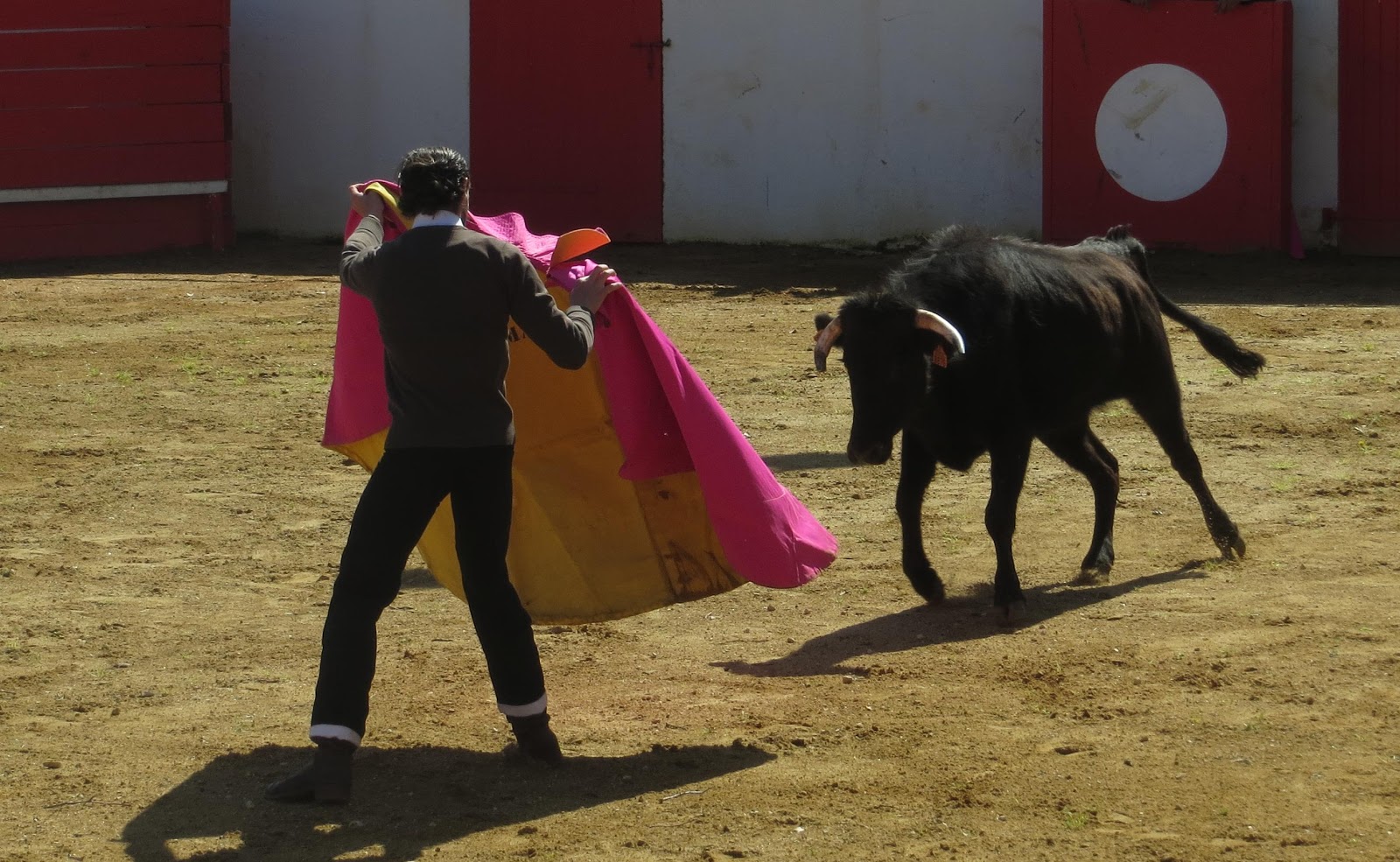
Becerrada


Our orchestra played this weekend at the becerrada in the warm March sunshine. 

Bullfighting is traditional in this part of France. Even small villages have an arena. The event was the becerrada where the baby bulls learn the ropes, and the younger matadors as well. No animals were hurt (or killed) although I'm sure the first bull gave a sigh of relief when they let him back in to his Mammy, who was waiting patiently. Wine and Armagnac was had by all (well, not the bulls--they're underage!)

Back to the desk tomorrow morning:
Delighted to see my recent flash fiction piece 'Just working on my tan...' has been published in The Galway Review

Tuesday, 19 March 2013

Writing West Midlands Short Fiction Comp Winner

Trying to Blossom:

Great news this week from the Writing West Midlands Short Fiction Competition 2013.

Kalashnikov for Shoes is the overall winner. I’m particularly pleased with the comments from guest judge, Tiffany Murray:

‘This is a big, sweeping journey. It’s one that tells the story of these particular characters, but also one that tells a story of a whole nation. It’s hard to get such ‘bigness’ into a very short story without becoming sweeping, general, or mawkish. I think Kalashnikov for Shoes succeeds. Of course it starts with a great title.’

Click here to read the rest of her comments and links to the other winning stories.


Sunday, 10 March 2013

Writing for Radio (RTE Arena Shortlisted)


RTE Radio 1’s Arena programme, together with New Island Books, is running a Creative Writing course every month, which is co-ordinated by writer Dave Lordan. Every month he gives a prompt and invites the listeners to participate. I was thrilled this month to have written one of the shortlisted stories ‘Don’t Mind Maggie!’

It was also a boost to hear Eoin Purcell, commissioning editor at New Island Books, giving positive feedback on the entries: ‘If these were the first four pages of four novels, I’d have asked for full novels from all of these writers. That’s how good they are…’

Another encouraging week!

Further details on Arena competition to be found here:


‘This month's creative writing prompt from Dave Lordan focuses on dialogue. It's called "The Universal Lottery"… Write what you have overheard in the form of a dialogue of less than 700 words and send it to arena@rte.ie by midnight on the 28th of March.’